


Portraits through history: who is the protagonist?
- Maria Cocu

- 28 ago 2020
- 2 min de lectura
When revolutions swept the European continent in the eighteenth and nineteenth centuries, disrupting and overthrowing the monarchies, they changed the use of painting. Subject matter shifted from the glorification of monarchies and triumphant battles to representations of the common man and the tragedies of war. A new kind of change—the Industrial Revolution—began to sweep Europe in the nineteenth century and fundamentally transformed the subjects, materials, centers, and markets for art.
A portrait where objects define the characters.

Jacques Louis David painted with absolute precision Lavoisier’s scientific instruments. We can see Lavoisier’s papers reflected in the measuring gadget, and the glass reveals the background with correct scale and perspective.
Why did Jacques Louis David put so much effort in representing mere objects? Because they represent who they wanted to be. They reinforce their identities: a smart and powerful couple. They are credited for discovering oxygen and the chemical composition of water.

It’s all about the texture, not the man.

The portrait changes with every varying texture and shape. Our vision concentrates on the upper half of the painting, where the light is.
Demi transparent strokes follow the folds of the turban, while the face is painted with dabs of paint that are not fully blended. The cloak is painted with sharp strokes above a golden base. As the figure fades into darkness, the size of the brushstrokes increases. The artist highlighted just a part of the cloak, enough to convince us of its luxury.
This painting was intended to attract a Dutch collector. It is not a portrait per se, since the character is purely fictional. The true subject of this picture is the illusion of rich textures.
Without the pearl, it would be nothing
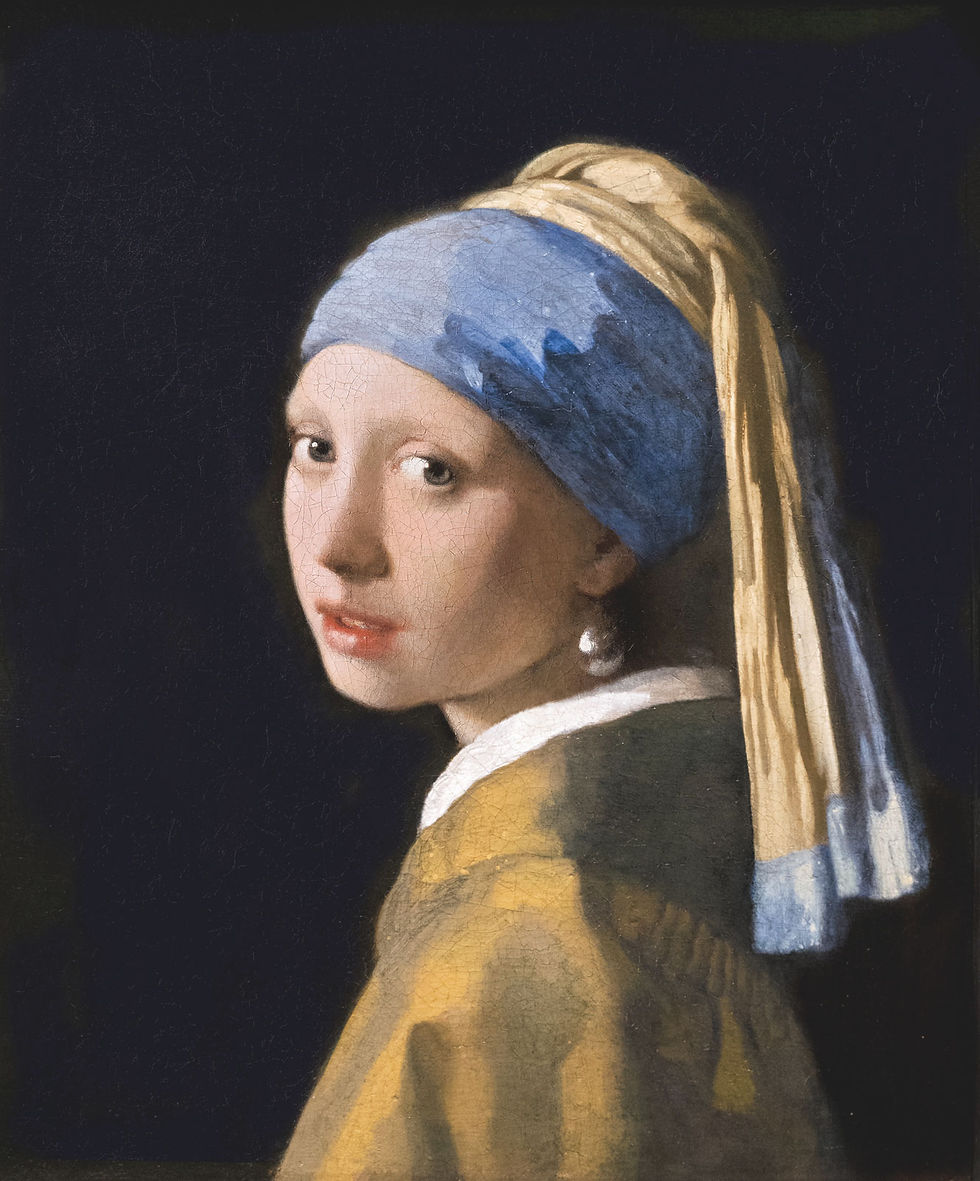
Pearls are said to symbolize wisdom, purity, generosity and integrity. In the Introduction to the Devout Life (1608), an important book published in Holland (where Vermeer is from) the writer said that women must protect their ears from unclean words with “the oriental pearls with the gospel”. So an inspired Vermeer painted a young innocent girl with an oriental turban and a huge pearl as an earring.
Vermeer might have had a muse but the painting is not meant to portray her or any specific individual in the same way that Leonardo’s piece portrayed an existing person. It is a study where the artist concentrates on creating shape with light instead of line.


Comentarios